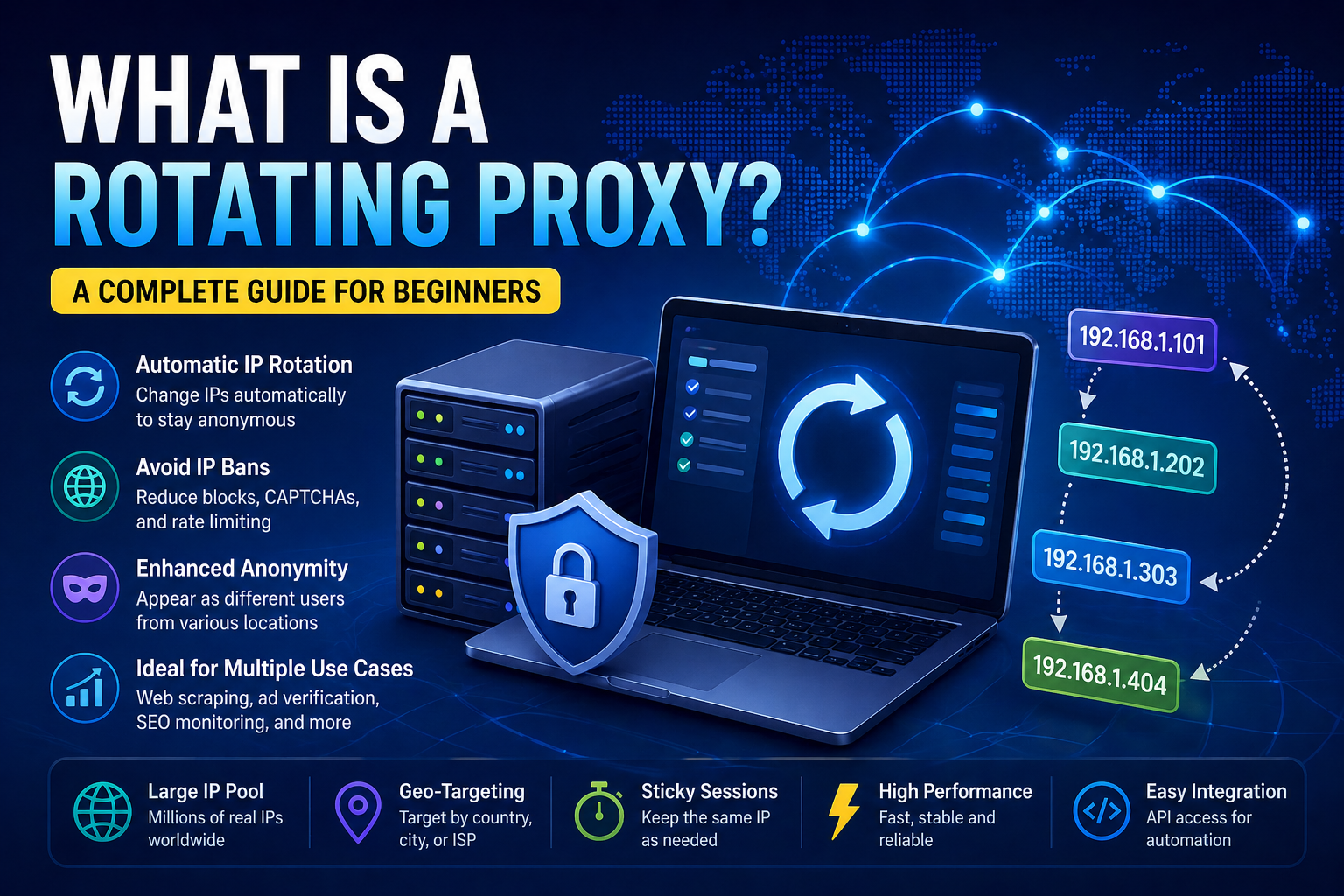
What Is a Rotating Proxy? A Complete Guide for Beginners
If you're involved in web scraping, SEO monitoring, social media automation, or ad verification, you've probably heard the term rotating proxy.
But what exactly is a rotating proxy, and why is it so important?
A rotating proxy helps users automatically change IP addresses during internet activity, making requests appear as if they come from different users and locations. This reduces the risk of detection, blocks, and CAPTCHAs.
In this guide, we’ll explain what a rotating proxy is, how it works, and when you should use one.
What Is a Rotating Proxy?
A rotating proxy is a proxy service that automatically changes your IP address after a certain number of requests, time intervals, or sessions.
Instead of using one static IP address for all traffic, the proxy rotates between multiple IPs from a larger proxy pool.
This makes your traffic appear more natural and helps avoid detection by websites.
How Does a Rotating Proxy Work?
The process is simple:
You send a request to a target website
The proxy server assigns an IP from its proxy pool
The request reaches the website from that IP
For the next request, a different IP may be assigned
This continues automatically without manual switching
This method is called automatic IP rotation.
Why Use a Rotating Proxy?
Using the same IP repeatedly can trigger:
IP bans
CAPTCHA challenges
Rate limiting
Account restrictions
Suspicious activity detection
A rotating proxy helps prevent these issues by constantly changing your IP footprint.
Types of Rotating Proxies
1. Rotating Residential Proxy
A rotating residential proxy uses real ISP-issued IP addresses from actual devices.
These are the most trusted and hardest to detect.
Best for:
Google scraping
eCommerce data collection
Social media management
Ad verification
Affiliate marketing traffic checks
2. Rotating Datacenter Proxy
These proxies rotate IPs from cloud servers or hosting providers.
They are faster and cheaper but easier for websites to detect.
Best for:
Bulk automation
SEO tools
Public data scraping
High-speed API requests
Rotating Proxy vs Static Proxy
| Feature | Rotating Proxy | Static Proxy |
|---|---|---|
| IP Changes | Automatic | Fixed |
| Detection Risk | Lower | Higher |
| CAPTCHA Risk | Lower | Higher |
| Session Stability | Medium | High |
| Best For | Scraping, Automation | Account Login |
If your goal is large-scale data collection, rotating proxies are usually the better choice.
Rotating Proxy for Web Scraping
One of the most popular use cases is rotating proxy for web scraping.
Why?
Because websites like Google, Amazon, Facebook, and TikTok monitor repeated requests from the same IP.
Without rotation, your scraper can quickly get blocked.
Rotating proxies help by:
Reducing ban rates
Improving scraping success rates
Supporting large request volumes
Accessing geo-specific content
Avoiding anti-bot systems
Rotating Proxy for Ad Verification
Media buyers and affiliate marketers often use rotating proxies to:
Check geo-targeted ads
Verify landing page behavior
Test Facebook Pixel events
Validate campaign routing
Monitor traffic quality
This is especially useful when managing international campaigns.
Proxy Pool: The Core of Rotation
A proxy pool is the collection of IP addresses used by the rotating proxy service.
The larger and cleaner the pool:
The better the anonymity
The lower the ban rate
The more stable the service
Premium providers often offer millions of residential IPs globally.
Are Rotating Proxies Safe?
Yes—if you use trusted providers.
Free proxies often have problems like:
Shared abuse history
Slow speed
Security risks
Data logging
Blacklisted IPs
Professional proxy services offer safer and more stable performance.
How to Choose a Good Rotating Proxy
Look for:
Large Residential IP Pool
More IPs = better rotation quality
Geo-Targeting Support
Country, city, or ISP-level targeting
Sticky Sessions
Allows you to keep the same IP temporarily when needed
Fast Response Speed
Especially important for scraping and automation
API Access
Useful for scaling systems and automation
Final Verdict
A rotating proxy is one of the most powerful tools for modern internet operations.
If you need:
Better anonymity
Safer web scraping
Reduced IP bans
Multi-location testing
Scalable automation
Then rotating proxies are often the best solution.
Conclusion
Understanding what a rotating proxy is helps businesses improve efficiency, reduce detection risks, and scale operations safely.
Whether you're collecting data, managing ad accounts, or running automation systems, rotating proxies provide the flexibility and protection you need.
For serious scraping and business use, a high-quality rotating residential proxy is often the best investment.