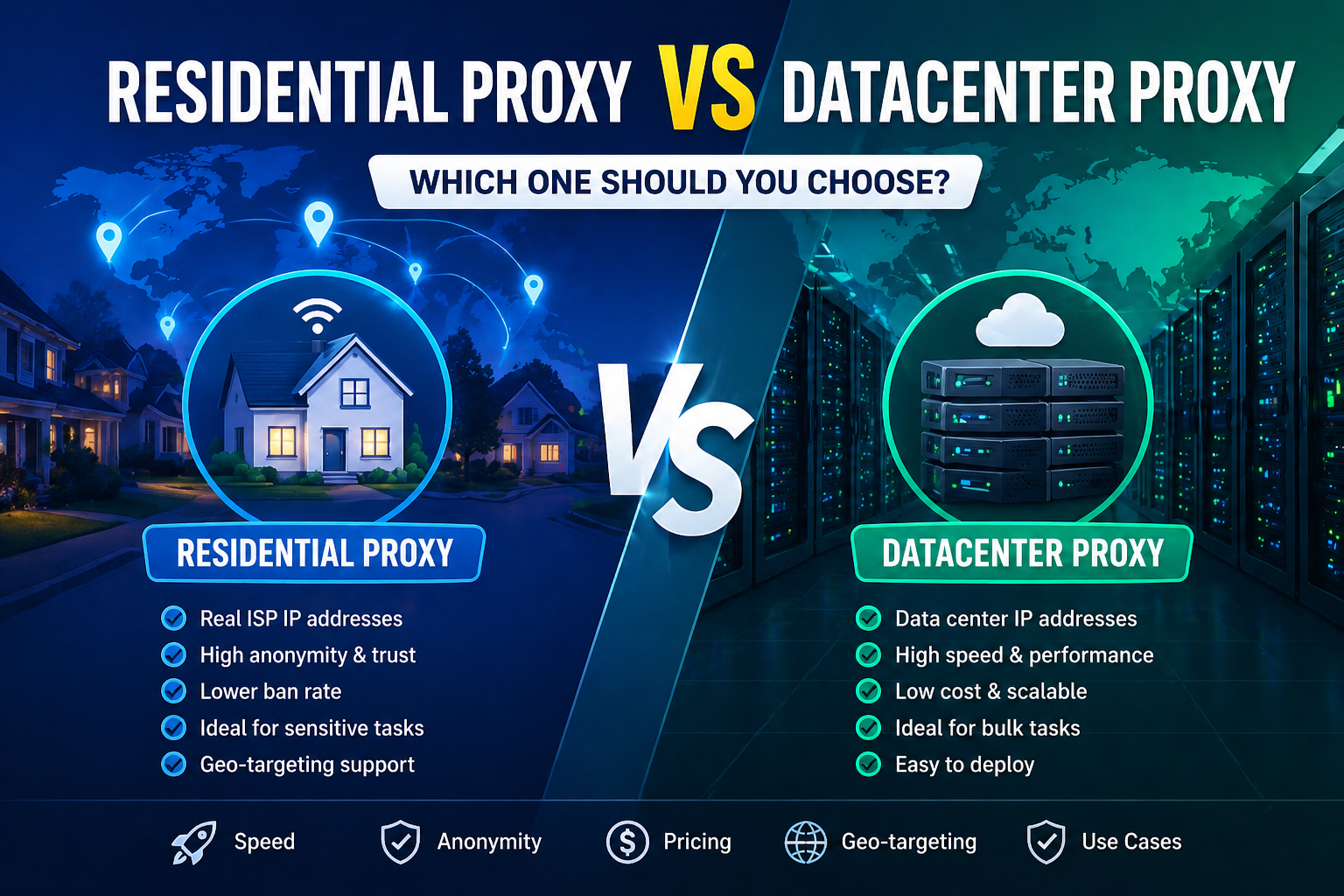
Residential Proxy vs Datacenter Proxy: Which One Should You Choose?
When choosing a proxy service, one of the most common questions is: Residential Proxy vs Datacenter Proxy — which is better?
Both proxy types help users hide their IP address, bypass restrictions, and improve online privacy. However, they work very differently and are designed for different purposes.
If you're involved in web scraping, SEO monitoring, ad verification, social media automation, or account management, choosing the right proxy can save time, reduce bans, and improve performance.
In this guide, we’ll break down the key differences between residential proxies and datacenter proxies, and help you decide which one fits your needs.
What Is a Residential Proxy?
A residential proxy uses real IP addresses assigned by Internet Service Providers (ISPs) to real devices such as home computers, mobile phones, and routers.
Because these IPs come from actual users, websites treat them as normal visitors, making them much harder to detect or block.
Key Features of Residential Proxies
- Real ISP-issued IP addresses
- High anonymity and trust score
- Lower chance of IP bans
- Supports geo-targeting by city/country
- Ideal for sensitive platforms
What Is a Datacenter Proxy?
A datacenter proxy uses IP addresses generated by cloud servers or hosting providers instead of residential internet connections.
These proxies are fast, stable, and cost-effective, but websites can often detect that they are not from real users.
Key Features of Datacenter Proxies
- Server-generated IP addresses
- Very high speed
- Lower cost
- Easy to scale in bulk
- Higher risk of detection
Residential Proxy vs Datacenter Proxy: Main Differences
| Feature | Residential Proxy | Datacenter Proxy |
|---|---|---|
| IP Source | Real ISP users | Cloud servers |
| Speed | Medium | Very Fast |
| Detection Risk | Very Low | Higher |
| Price | Expensive | Affordable |
| Geo Accuracy | Very High | Medium |
| Stability | High | Very High |
| Best For | Scraping, Ads, Accounts | SEO, Bulk Tasks |
Which Proxy Is Better for Web Scraping?
If you're asking for the best proxy for web scraping, the answer depends on your target.
Use Residential Proxies When:
- Scraping Google Search results
- Accessing eCommerce websites
- Collecting social media data
- Avoiding CAPTCHA and bans
- Running ad verification campaigns
Use Datacenter Proxies When:
- Scraping public websites
- Running high-volume automation
- Monitoring rankings at scale
- Fast API requests
- Cost optimization matters
Residential Proxy for Ad Verification
For advertisers and media buyers, residential proxies are usually the better option.
Why?
Because ad platforms like Facebook, Google, and TikTok use strong fraud detection systems. Residential IPs appear as real users, which improves trust and reduces risk.
This is especially useful for:
- Facebook ad account management
- Pixel event testing
- Geo-targeted ad verification
- Affiliate traffic quality checks
Datacenter Proxy for SEO Tools
If you're using rank trackers, keyword tools, or SERP monitoring systems, datacenter proxies are often the better choice.
They provide:
- Faster response times
- Lower cost for large-scale monitoring
- Stable long-term sessions
- Easy integration with automation systems
Price Comparison
Residential Proxy Pricing
Usually charged by:
- GB bandwidth usage
- Premium IP quality
- Geographic targeting
Typical cost: Higher
Datacenter Proxy Pricing
Usually charged by:
- Number of IPs
- Monthly subscription
- Dedicated or shared plans
Typical cost: Lower
Can You Use Both?
Yes — and many professionals do.
A common strategy is:
- Use datacenter proxies for bulk tasks
- Use residential proxies for sensitive operations
This hybrid approach improves both efficiency and reliability.
Final Verdict
There is no single “best” proxy.
Choose Residential Proxy If:
- You need high trust and low detection
- You manage ad accounts
- You scrape protected websites
- You require location precision
Choose Datacenter Proxy If:
- You need speed and scale
- Budget matters most
- You run SEO monitoring
- You automate public tasks
The best proxy depends on your business goals.
Conclusion
Understanding residential proxy vs datacenter proxy helps you avoid unnecessary costs and improve your online operations.
Whether you're managing traffic, verifying ads, or scaling data collection, selecting the right proxy type is a critical decision.
Start with your use case first—then choose the proxy that matches your real business needs.